
Back to School Edition: Chapter One of Three
Perhaps it’s my kid’s return to school this week, and their entry into an environment of structured, scientific learning that has me looking at the wine in our inventory in a more analytic manner than usual.
Perhaps it’s just that I’m actually a nerd.
I accept that both can be true at the same time.
Either way, let’s dive in.
The labeling laws for German Riesling communicate the significant details about who, where, when, and several of the hows of the wine’s creation. With fluency in the labels, you can get a better idea of “what” is actually in the bottle before you open it.
It’s a pretty cool system!
But, it is a lot of information, which can feel overwhelming. The good news: it’s based on a structured, scientific approach to measurable details and logic.
So, in the spirit of science and fun, I’ve designed three very delicious Riesling packs you can take home….Err, three very scientific experiments to be conducted for very serious science education purposes.
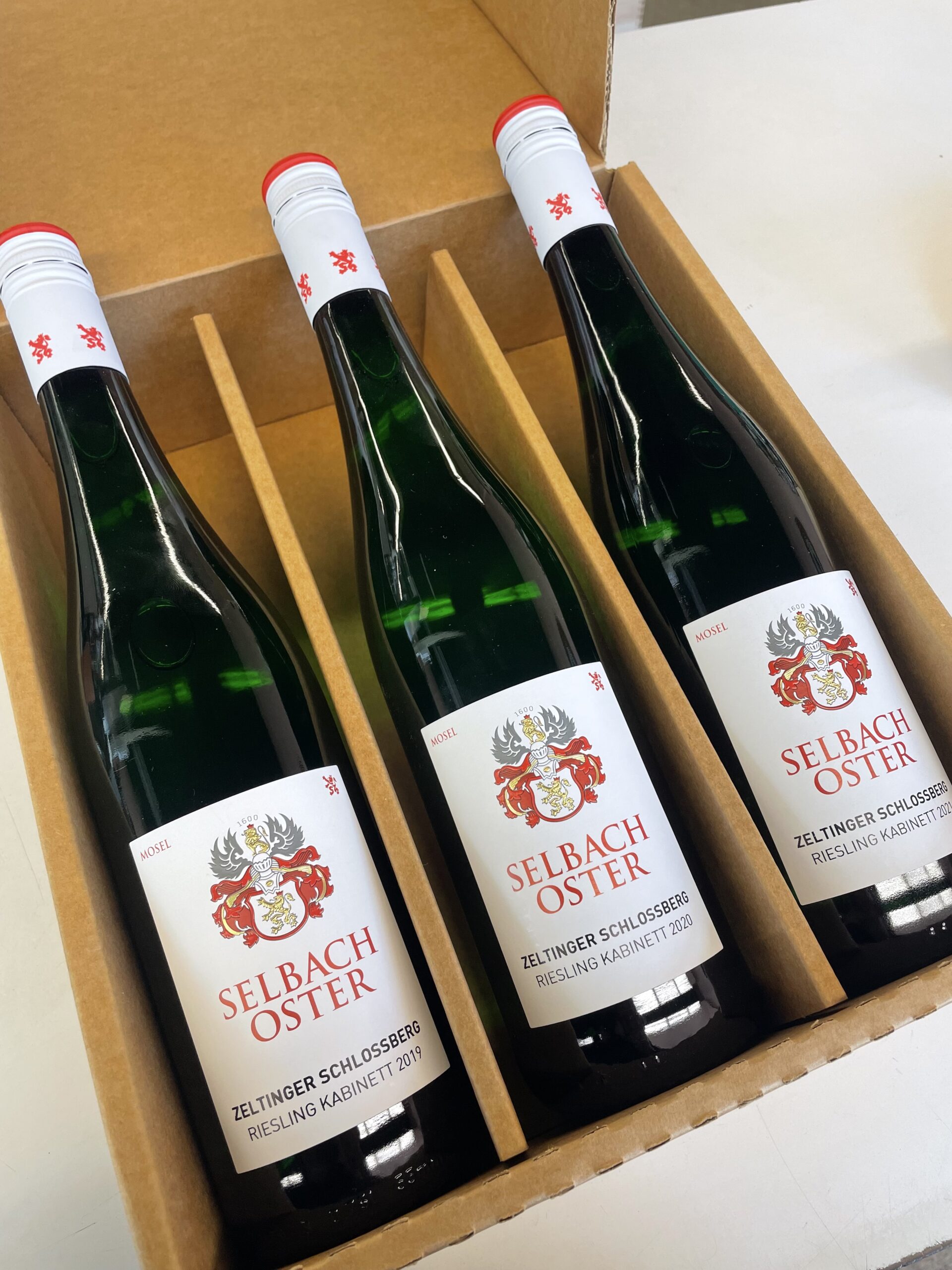
Experiment One: Vintage
- Enjoy three wines from the same vineyard site, (Zeltinger Schlossberg), vinified by the same winemaker, (Selbach-Oster) and each harvested at the same ripeness classification, (Kabinett).
- Controls
- Vineyard: Zeltinger Schlossberg
- Winemaker: Selbach-Oster
- Prädikat: Kabinett
- Variable: Vintage
- 2019
- 2020
- 2021
- According to vintage reports for the Mosel region, 2019 is celebrated as a classic, deeply concentrated year balancing rich ripeness with vibrant acidity; 2020 delivered a lighter, more approachable, and softer style with lower acid; and 2021 marked an electric, old-school cool-climate return defined by searing, racy acidity and laser-focused tension.
- Will your tasting of these three wines show the same results? Will you have a favorite?
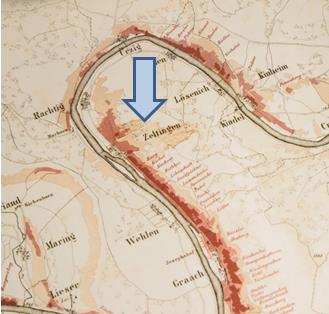
About Zeltinger Schlossberg:
Soil Type: Blue Devonian slate
A Grosse Lage, or Grand Cru, site, steeper overall than Himmelrich, but in comparison to Zeltinger Sonnenuhr, Schlossberg has deeper subsoil of crumbly, broken slate, mixed with organic matter and loam. The vineyard is also further from the Mosel river and gets less of the moderating effect from the wide water surface. The lower sections of Schlossberg (Bömer and Schmitt) are close to the mainly stone houses in the village, which radiate warmth back into the vineyard. The Kabinett produced from this site comes from the higher, cooler parcels closer to the forest which maintain excellent acidity and full aromatic ripeness without too much residual sugar. This is a Kabinett exactly in the style that Johannes Selbach likes to make – firm, crunchy, mineral without an excess of sweetness.
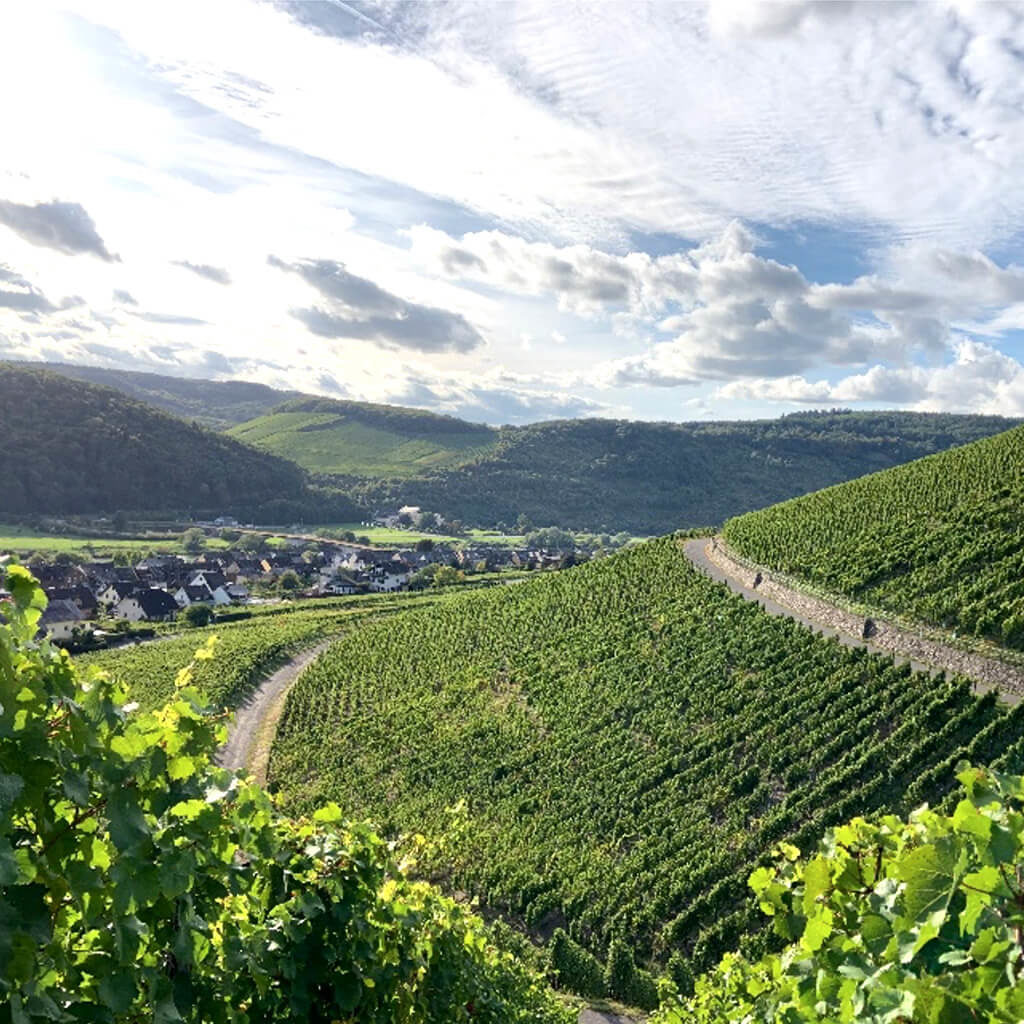
About Selbach-Oster:
Today, Johannes Selbach and his wife Barbara, with the help of son Sebastian, manage their vineyards and winery with passion and respect for the estate’s long held traditions. A substantial portion their 24 hectares of vines are on their original rootstocks, in Zeltinger, Schlossberg, and Sonnenuhr; Wehlener Sonnenuhr; and, Graacher and Bernkasteler Graben. These vineyards of weathered Devonian slate are on a steep, contiguous slope facing south-south west and represent some of the most prestigious sites in all of the Middle Mosel, in fact 85% of the Selbach’s vines are on steep slopes. The Selbach family’s heritage in the wine business dates to 1600: Selbach’s ancestors shipped wines down the Mosel in their own ships, the wine carried in oak barrels made by cooper Matthias Oster, the great-grandfather on the paternal side of the family. Thus, the winery developed as both a top estate producing some of the region’s best wine, and also as a négociant and brokerage firm, consolidating the production of smaller growers.
Johannes, like his late father Hans, has continued the use of traditional 1000 L oak fuder in his cellar, bringing in new large casks every few years. Vinification is carried out in a combination of fuder and stainless steel, in a hands-off manner with no fining, and with wild yeasts. The focus is on meticulous work in the vineyard (organic and sustainable farming) with the aim to produce and bring home perfect fruit. Because their approach in winemaking is minimal, Johannes and Sebastian will allow wines to ferment naturally, as slow or as complete as manifest, resulting in more dry wines in some vintages and more fruity wines in others.
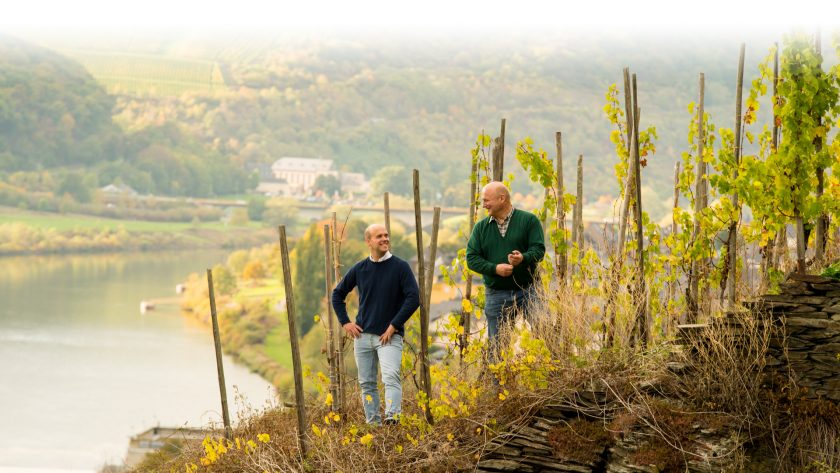
Vineyard and producer profiles courtesy of importer Skurnik
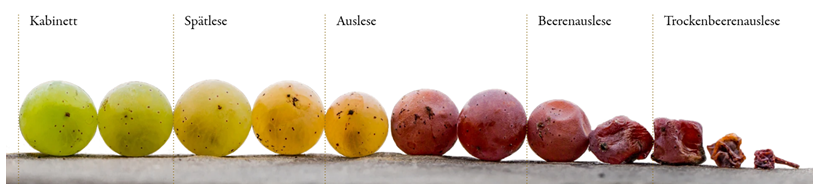
The image below offers a good visual representation of what Riesling grapes look like at each of the five primary prädikat levels. The three wines presented in this experiment are all Kabinett level.
Set of 3 wines $74
Order the Riesling, Right Now!
Back-to-School Set #1
Stay tuned for
Experiment Two: Prädikat
and
Experiment Three: Region/Producer Variation